
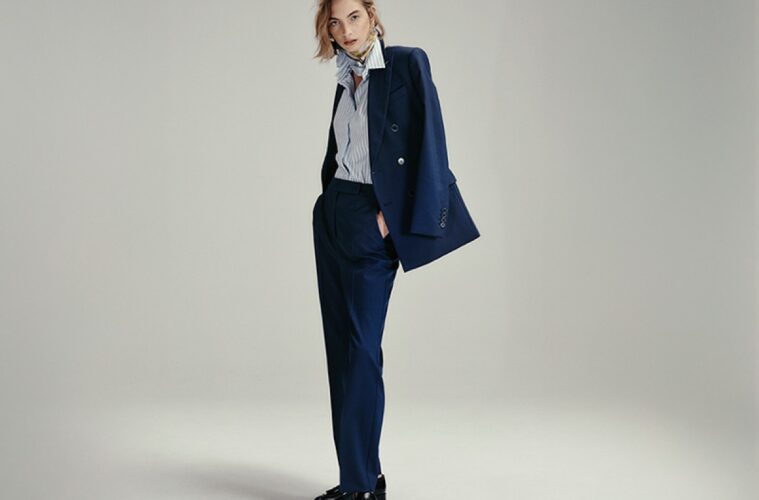
Work no longer occupies a single, clearly defined space. It extends beyond offices, overlaps with personal time and adapts to routines that change from one day to the next. As professional life becomes more fluid, the concept of a working wardrobe evolves with it.
In this context, the tailored suit takes on a role that goes beyond formality, becoming a functional component within a broader system of everyday dressing. Rather than representing a fixed idea of professionalism, it now operates as a stabilising element within wardrobes built for continuity. Its purpose is not to signal status or occasion, but to support work that happens across different settings and rhythms.
A working wardrobe built for consistency
Modern working wardrobes are designed around repetition rather than exception. They rely on pieces that can be worn frequently without losing relevance, allowing focus to remain on activity rather than appearance. Within this structure, the tailored suit offers consistency.
Its proportions and construction create a dependable framework that can be returned to day after day. This reliability makes it less of a statement and more of a reference point – a garment that anchors the wardrobe while other elements rotate.
Function beyond formality
In contemporary dressing, function is no longer limited to performance or comfort. It includes clarity, ease of use and the ability to move between tasks without interruption. A tailored suit contributes to this expanded definition of function by maintaining visual order without imposing rigidity.
Rather than dictating how the rest of the outfit should behave, it provides a base that absorbs variation. It allows different combinations to work without constant recalibration, making it particularly effective in workdays that extend beyond a single environment. Formality becomes secondary to usability, and the suit adapts accordingly.
Supporting focus through structure
One of the understated roles of a tailored suit in a working wardrobe is its impact on focus. Clothing that feels uncertain or requires adjustment can distract from the task at hand. The structure of a suit reduces this distraction by offering predictability.
Once worn, it establishes proportion and balance that remain consistent throughout the day. This steadiness removes the need to think about appearance, allowing attention to shift towards work itself. In this way, tailoring supports productivity indirectly, not by enhancing performance, but by eliminating friction.
Integration within a modular wardrobe
Modern wardrobes increasingly operate on a modular logic. Pieces are selected for how easily they integrate with others, rather than for their individual impact. Women’s tailored suits fit naturally into this approach.
Their components work independently as well as together, interacting smoothly with items designed for different levels of formality. This modularity allows them to remain relevant even as the boundaries between work and non-work settings blur. They do not need to be reserved for specific occasions – they function as part of a system designed for everyday use.
Longevity through relevance
Relevance, rather than novelty, defines longevity in a working wardrobe. Garments that remain useful across changing contexts are more likely to be worn consistently. The tailored suit achieves this by aligning with the realities of modern work rather than resisting them.
Its role is not to stand out, but to endure. By offering structure that adapts to evolving routines, the suit maintains its place without demanding attention. This quiet relevance ensures it continues to function effectively as work patterns shift.
A practical constant in contemporary work life
The tailored suit remains central to the modern working wardrobe because it fulfils a practical role. It provides structure without restriction, consistency without rigidity and clarity without excess.
In work environments defined by change, this balance matters. The suit does not define what work looks like – it supports how work happens. By operating as a reliable, integrated element within a flexible wardrobe, it continues to serve a purpose that extends well beyond traditional ideas of formality.
Max Mara and tailoring as part of a complete wardrobe
In contemporary wardrobes, tailoring no longer exists in isolation. It has become part of a broader system of dressing, shaped by continuity rather than occasion. Max Mara has long embraced this perspective, interpreting tailoring as an everyday resource rather than a formal statement.
Since 1951, the Maison has approached design with a clear objective: to create garments that integrate naturally into women’s lives, supporting their routines, ambitions and transitions with consistency and ease.
The Max Mara woman builds her wardrobe around coherence. She values pieces that communicate authority without rigidity and refinement without excess. For her, tailoring is not about ceremony but about structure – garments that provide clarity, reliability and a sense of alignment throughout the day.
This approach is rooted in the brand’s broader design philosophy, where proportion, construction and material choice work together to serve function as much as expression. Alongside its iconic outerwear, Max Mara has developed tailored suits that extend the same architectural intelligence into formal dressing. Jackets and trousers are designed to balance definition and comfort, offering silhouettes that feel composed while remaining responsive to movement.
Within this framework, the Tailored Suit Project represents a refined exploration of the Maison’s expertise. Each piece is constructed with internal canvases, carefully selected fabrics and hand-finished details, requiring over 345 minutes of work. The result is a suit that feels grounded in tradition yet aligned with contemporary expectations – precise in structure, fluid in wear, and deliberately understated in presence.
Through this perspective, Max Mara continues to define a vision of elegance built on continuity rather than emphasis – where form, function and identity remain aligned across time and context. Garments are conceived to support women with clarity and intention, offering a refined sense of stability that feels both contemporary and enduring.